100-Amp vs 200-Amp Electrical Service
If you are trying to decide between 100-amp and 200-amp electrical service, the simple question is this: can your current service safely handle how your home actually uses power now and in the near future? The right answer depends on your panel, wiring, major appliances, future plans, permits, and local code.
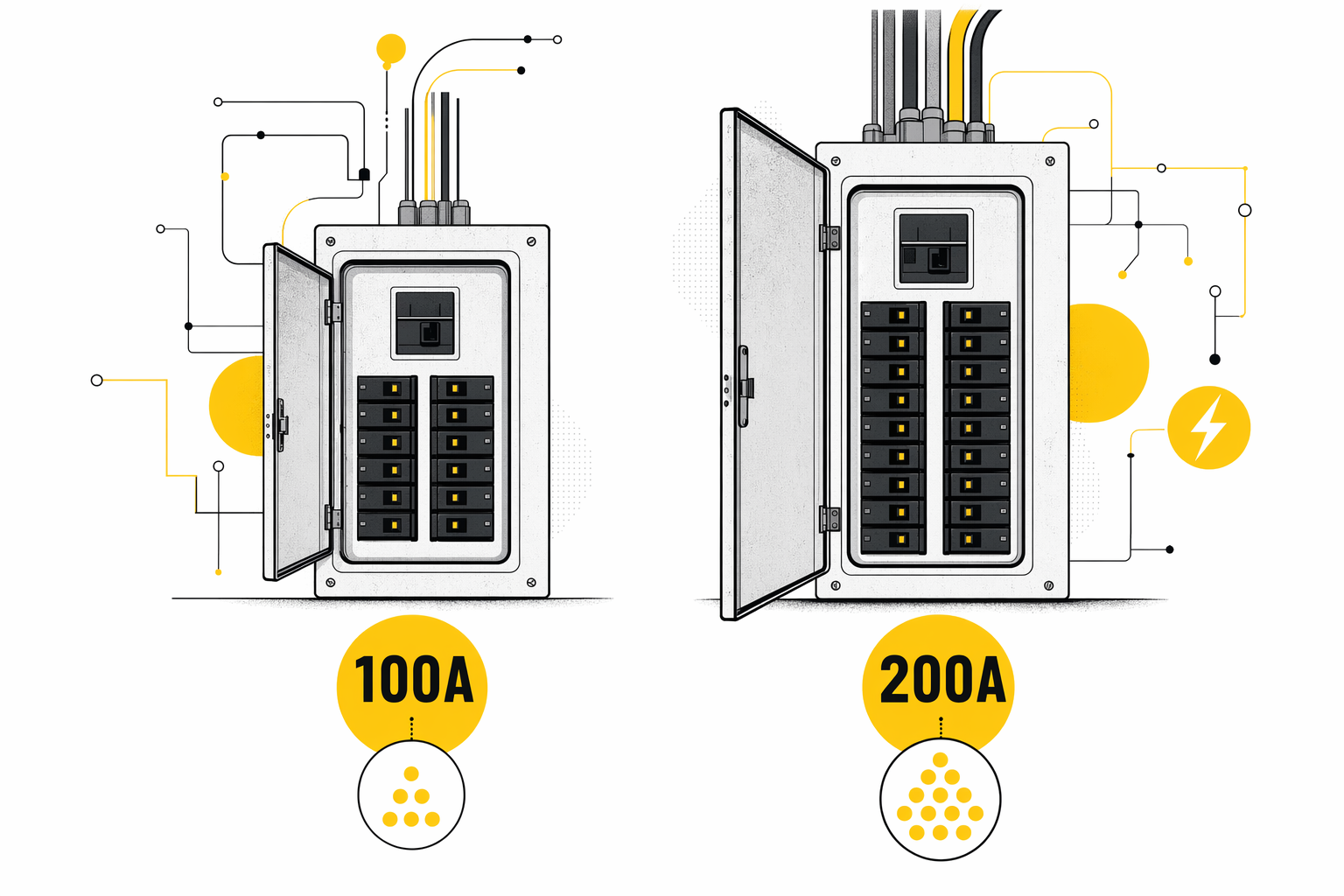
The short answer
For many older, smaller homes, 100-amp service may still be enough if the home has modest power needs and no big new loads. For many homes today, 200-amp service gives more room for modern life: central air, electric dryers, newer kitchens, home offices, hot tubs, workshops, and EV charging.
That does not mean every home should automatically upgrade. A bigger number is not always the best use of money. The real question is whether your current service is already at its limit, or will be soon.
A licensed electrician can evaluate:
- your main service size
- the panel condition and available spaces
- the wiring type and age
- major appliances and heating/cooling loads
- planned additions like an EV charger or finished basement
- what your local utility and permit office require
If you are seeing flickering lights, frequent breaker trips, or you are planning a major new load, it may be time to have the service reviewed. If there is burning smell, smoke, sparks, heat, or shocks, stop using that circuit and call a licensed electrician now. If there is smoke or fire, call 911.
You can also compare local options through VoltGuide's free matching service.
What 100 amps vs 200 amps really means
Your home's service amperage is the amount of electrical capacity available from the utility into the home. In plain English, it is part of what determines how much power the house can use at one time.
A 100-amp service is common in older homes. It may be workable if the home is smaller and uses fewer large electric appliances.
A 200-amp service is common in many newer homes and in older homes that have been updated. It usually gives more capacity for today's equipment and future upgrades.
Here is the honest part: homeowners often say "I need a 200-amp panel," but the panel alone is not always the whole issue. A true service upgrade can involve more than replacing the box.
It may include:
- a new panel
- a new main breaker sized for the service
- meter equipment or service entrance updates
- grounding and bonding corrections
- utility coordination
- permit and inspection requirements
That is why prices vary so much. The final cost depends on the panel, the wiring, the scope, the materials, permits, and your area.
Typical cost for a panel upgrade to 200 amps is often about $1,800-$4,500. In some homes, especially where service equipment, meter work, code updates, or utility changes are needed, the total can go higher. For more background on pricing, see electrical costs and our page on panel upgrades.
Signs 100-amp service may no longer be enough
No single sign proves you need 200 amps, but these are common reasons homeowners start the conversation:
1. You are adding major electric loads
- Level 2 EV charger
- electric range or double oven
- electric water heater
- heat pump or central AC
- hot tub
- workshop tools
- accessory dwelling unit or major addition
2. Your panel is crowded
- no room for new breakers
- lots of tandem or double-stuffed breakers where not appropriate
- messy older modifications
3. Breakers trip during normal use
- especially when several large appliances run at once
- or when seasonal loads like AC push the system harder
4. The home still has aging electrical infrastructure
- older panel brands with a poor reputation
- outdated service equipment
- old wiring concerns that need a full review
5. You are planning for the next 5-10 years
Sometimes the smart move is not about today's load. It is about avoiding repeat work when you know an EV charger, renovation, or electrification project is coming.
A 100-amp home can be perfectly livable. But if you are constantly juggling appliances or hitting capacity limits, an upgrade may save hassle and make future work easier.
If your question is really about whether the whole house wiring is old, not just the service size, read rewiring.
When 100 amps may still be fine
A lot of homeowners get pushed toward upgrades they may not need. Sometimes 100 amps is still reasonable.
Examples where 100-amp service may still be enough:
- smaller home or condo
- gas heat, gas water heater, and gas range
- no EV charger planned
- no central AC or only modest cooling load
- no workshop, hot tub, or large addition planned
- panel is in good condition and code issues are limited
That does not mean you should guess. It means you should ask for a real load evaluation from a licensed, insured, and bonded electrician.
A good electrician should explain:
- what your current service size is
- whether the panel itself is unsafe, obsolete, or simply small
- whether the issue is capacity, condition, or both
- whether a subpanel could solve a space problem without a full service upgrade
- what permit and inspection steps apply locally
Ask questions in simple terms. You do not need to know technical language to protect yourself. If the explanation is vague or pushy, get another opinion. Before you hire, check the electrician's license and verify it yourself.
How to decide what to do next
Use this simple process:
1. List your current and planned big loads
Write down things like AC, electric dryer, oven, water heater, EV charger, hot tub, or planned addition. Future plans matter.
2. Ask for an on-site evaluation
Do not accept a blind price by text alone for service work. A real evaluation helps uncover panel condition, wiring issues, meter concerns, and permit needs.
3. Get at least 2-3 written estimates
Compare the scope, not just the price. Make sure each estimate says what is included: panel, breakers, grounding, permit handling, utility coordination, patching, inspection, and warranty terms.
4. Verify license, insurance, and bond
Hire only licensed, insured, and bonded electricians. Verify the license yourself. Follow local permit and code rules.
5. Do not pay for vague promises
Get the total scope and price in writing before any deposit. You compare quotes. You choose who to hire. You hold the final payment until the agreed work is done.
VoltGuide is free for homeowners. We help you understand the job and get matched with local electricians. If you want to compare options, start here: get matched.
A few cost expectations homeowners should know
Electrical pricing is not one-size-fits-all. Service upgrades are affected by labor, materials, permits, utility coordination, and what the electrician finds once the equipment is inspected.
Typical ranges homeowners often see:
- Service call: $120-$400
- Electricians' labor: often about $50-$130 per hour, or a flat rate per job
- Panel upgrade to 200 amps: often about $1,800-$4,500
- Level 2 EV charger install: often about $600-$2,200, depending heavily on distance, panel capacity, and circuit needs
Important: these are typical ranges and estimates, not quotes or guarantees. The real price depends on the panel, the wiring, the scope, the materials, permits, and the area.
If your interest in 200 amps is mostly because of a future EV, it helps to look at EV charger installation before you decide. In some homes, the charger project and service upgrade are closely connected.
If your home is older or you plan to add big electric loads like an EV charger, AC, or a hot tub, ask a licensed electrician whether 100 amps is still enough or if 200 amps makes sense. Get 2-3 written estimates, verify the license yourself, and compare the full scope before you pay a deposit.